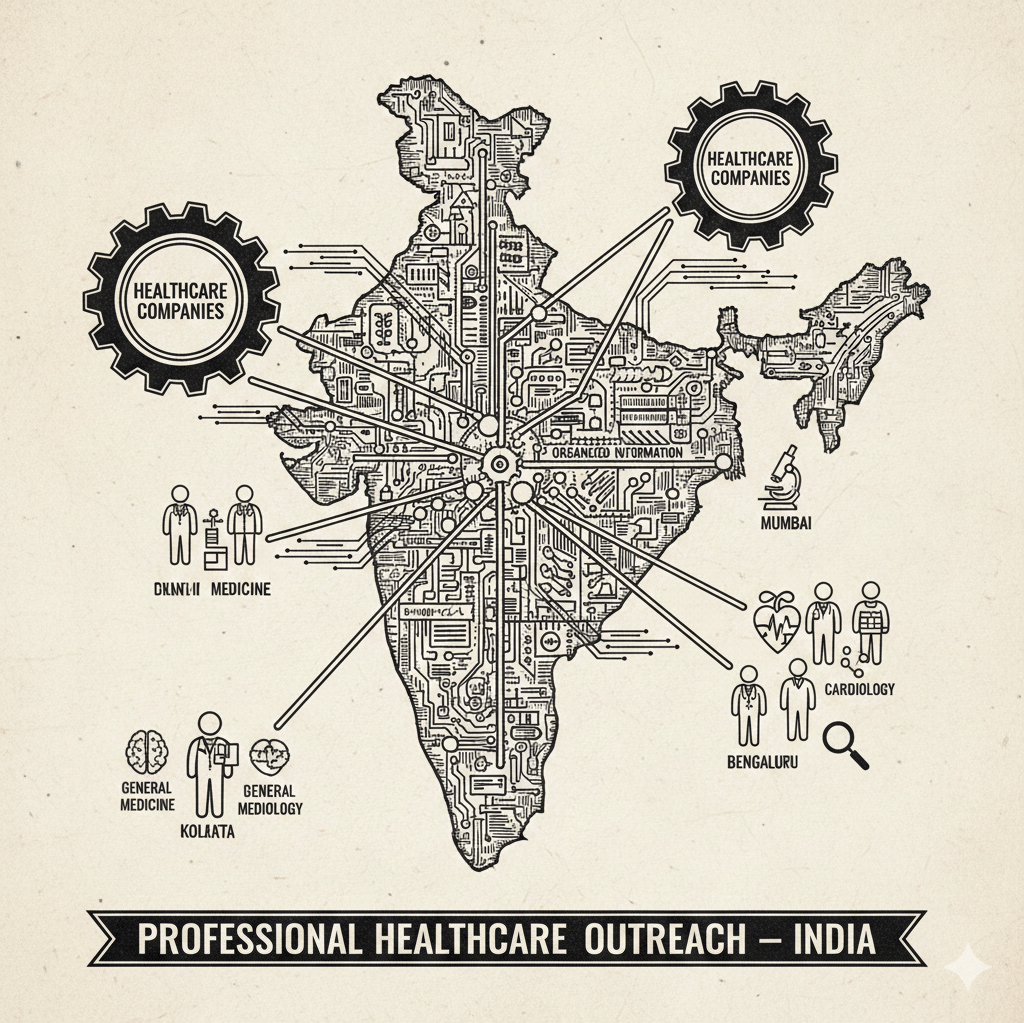
Finding the right doctors to engage with is one of the biggest challenges for healthcare companies in India. Pharmaceutical brands, healthtech startups, medical device manufacturers, and healthcare agencies often struggle to identify and reach doctors by specialty and city without relying on slow lead generation, advertisements, or long field cycles.
As India’s healthcare ecosystem grows, businesses increasingly need structured, specialty-based doctor direct access to support professional outreach, partnerships, and market expansion.
This article explains how healthcare companies find doctors in India, why specialty- and city-based targeting matters, and what best practices businesses follow today.
Why Finding Doctors by Specialty Matters
Doctors in India are highly specialized. A cardiologist, orthopedic doctor, neurologist, or oncologist operates in very different clinical, commercial, and decision-making environments.
For healthcare companies, reaching doctors by relevant specialty helps to:
Improve relevance of communication
Reduce wasted outreach
Shorten sales and partnership cycles
Increase response rates
Targeting doctors by specialty is now considered a basic requirement for professional healthcare outreach.
Importance of City-Based Doctor Targeting in India
India’s healthcare landscape is geographically concentrated. Cities like Mumbai, Delhi NCR, Bengaluru, Chennai, Hyderabad, and Pune host a large share of specialist doctors, hospitals, and clinics.
City-based targeting allows healthcare companies to:
Focus on high-density medical hubs
Align outreach with regional healthcare demand
Support territory-wise sales and marketing strategies
Common Ways Healthcare Companies Find Doctors in India
1. Hospital and Clinic Websites
Many companies start by checking hospital or clinic websites. However, this method is:
Time-consuming
Inconsistent
Difficult to scale across multiple cities and specialties
2. Medical Directories and Associations
Professional medical associations and directories provide partial doctor listings. These sources are useful for validation but often lack complete contact information.
https://www.nmc.org.in/information-desk/indian-medical-register/
3. Conferences and Medical Events
Healthcare conferences help companies discover doctors within specific specialties. However, events are:
Periodic
Location-limited
Not suitable for continuous outreach
you can check when is confrence happening.
4. Traditional Field Representative–Led Outreach
For decades, healthcare companies in India have depended heavily on field representatives (MRs) to reach doctors. While this model worked in the past, it has become increasingly time-consuming and inefficient in today’s healthcare environment.
Field representatives often spend weeks trying to secure appointments, waiting outside clinics, navigating gatekeepers, and managing territory-based limitations. This approach results in:
Long outreach cycles
Limited daily doctor interactions
High operational costs
Inconsistent coverage across cities and specialties
As doctor availability becomes more restricted and healthcare markets more competitive, relying solely on field-based outreach slows down business growth. Modern healthcare teams now look for structured, specialty- and city-based doctor discovery to complement or replace traditional field efforts and improve speed, reach, and efficiency.
5. Doctors Access
Today, healthcare companies are moving toward direct doctor access - where doctors are organized clearly by specialty and city instead of relying on scattered sources.
Doctors Access is built specifically for this purpose.
It enables healthcare businesses to find and reach doctors through a structured, specialty- and city-based system designed for professional outreach. This approach removes the need for manual searching, ad-based lead waiting, or prolonged field efforts.
By organizing doctors in a clear and structured way, healthcare teams are able to save time, improve relevance, and scale outreach more efficiently.
find doctors by specialty and city
👉https://doctorsaccess.in/services-connect-with-doctors-directly
Key Medical Specialties Healthcare Companies Search For
Based on industry demand, the most searched doctor specialties in India include:
Cardiologists
Orthopedic doctors
Neurologists
Oncologists
Dermatologists
Gynecologists
Pediatricians
ENT doctors
Ophthalmologists
Gastroenterologists
These specialties are critical for pharmaceutical marketing, medical devices, diagnostics, and healthtech solutions.
Different Types of Doctors Specialists Explained 👇
https://www.webmd.com/health-insurance/insurance-doctor-types
Best Practices for Professional Doctor Outreach
Healthcare companies that successfully engage doctors follow a few best practices:
Use specialty-specific targeting rather than generic lists
Segment doctors by city to match regional strategies
Avoid patient-focused messaging in professional outreach
Verify doctor information before starting communication
Focus on relevance over volume
This approach improves trust and long-term engagement with medical professionals.
Professional Use Disclaimer
Doctor access and contact information discussed in this article are intended only for professional healthcare outreach.
This information is not meant for patient consultations, appointments, or medical advice.
Conclusion
As India’s healthcare market becomes more competitive, healthcare companies must move beyond traditional methods of finding doctors. Specialty- and city-based doctor access has become essential for efficient, relevant, and scalable professional outreach.
By focusing on structured access, verification, and relevance, healthcare businesses can connect with the right doctors while saving time and resources.